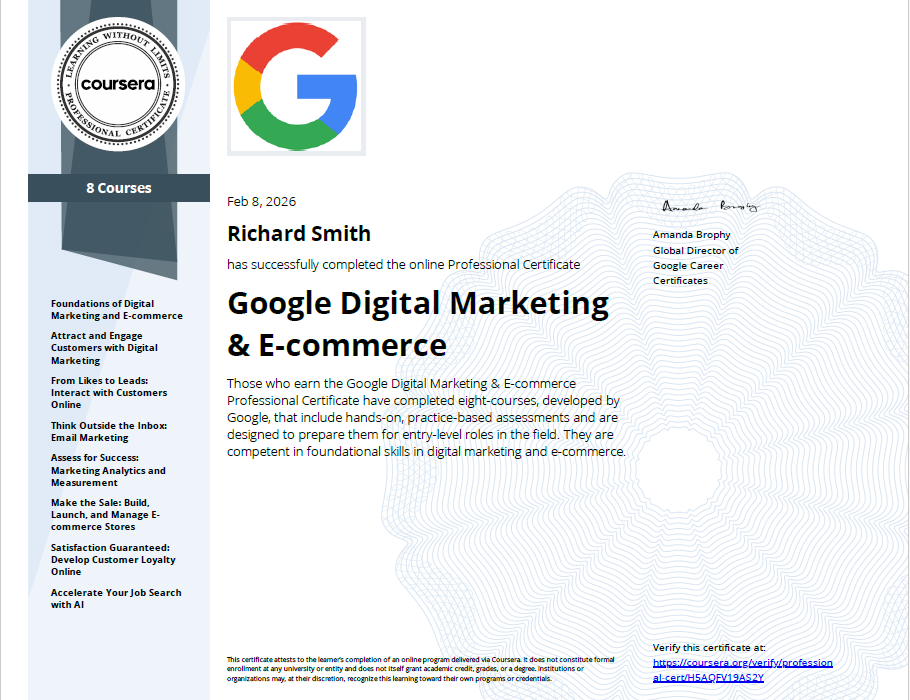
When Patience Meets Patterns: Why I Studied Digital Marketing to Solve a Product Problem
There are achievements that check a box, and then there are the ones that reveal something back to you. Completing the Google Digital Marketing & E-commerce Professional Certificate (v2) wasn’t about switching lanes. It was about understanding a pattern I had felt for years but could never quite name.
I’ve always been a learner. Twenty years of it, in fact. But this time, something felt different. I wasn’t chasing a new credential. I was trying to understand why the work I’d been doing breaking down problems, clarifying ambiguity, guiding teams toward shared decisions was starting to feel... harder to land. Not harder to do. Harder to share.
And then slowly, like something turning to face the light, I saw it.
A Mind Full of Insights, and Nowhere to Put Them
In any given week, I’d uncover patterns in the way users behaved, surface quiet risks inside backlogs, or observe communication gaps before they widened. These weren’t “nice to know” insights. They were foundational. But the challenge wasn’t in seeing them, it was in getting them heard.
As time moved on, the people I collaborated with had less space for context. More noise, shorter attention spans, heavier plates. It wasn’t just the pace of business it was the mental load. In eight hours, I could find more than I could meaningfully convey. And that was before AI brought a tidal wave of generated content into every room.
It became clear: the challenge wasn’t lack of insight. It was lack of capacity to absorb it.

Marketing as a Mirror, Not a Megaphone
What drew me to digital marketing wasn’t the metrics, or the campaign logic, or even the toolkits, though all of that is valuable. What pulled me in, almost unconsciously, was how marketers manage attention. Not demand it. Guide it. They don’t just create content; they sequence it. They anticipate resistance. They tell a story in pieces, and trust the arc.
And somewhere in that recognition, I saw how this approach could unlock a stuck pattern in product teams. Where clarity gets buried. Where context gets lost. Where we say, “we’ve been working on this for months,” and still wonder why it doesn’t land.
Digital marketers think in funnels. Micro-conversions. Nudges. Journeys. They know that trust is built in quiet, cumulative moments not in one-shot slide decks. And maybe, I thought, that’s exactly what internal collaboration has been missing.
The Quiet Friction of Cross-Functional Work
In agile environments, we assume alignment is built through ceremonies and shared backlogs. But often, the real thread that holds a product story together slips through the cracks. People forget why we chose a direction. They remember the tasks but lose the meaning. And then someone, usually higher up, says: “We’ve been at this a while. What do we have to show for it?”
It’s not a question of productivity. It’s a sign that the narrative thread has broken.
What I learned through this certificate was how to apply marketing thinking not to sell an idea, but to hold it in view long enough for people to see their part in it. To layer insight gradually. To design internal communication the way you’d design a campaign: with rhythm, relevance, and a human pace.
A Different Tempo.
Yes, I learned the mechanics, how to track behavior, refine conversion flows, tailor messaging. But more than that, I learned I must slow down my delivery so others could catch up. Not by dumbing things down, but by sequencing them. Respecting the thresholds of busy minds. Letting trust build naturally, not forcefully.
That’s what made it click: marketing is a form of patient design. It doesn’t rush the audience. It invites them forward, step by step.
And now I find myself doing the same not just externally, but within product teams. Creating clarity through journeys. Framing decisions like signposts. Leaving space for people to arrive at understanding on their own terms.
And Then Came AI
AI changed the velocity. It made it easier than ever to create content. But it didn’t solve for meaning. If anything, it made the role of intentional communication more vital. Without context, AI-generated messaging can feel like static plausible, even insightful, but disconnected from the heart of the work.
And so we’re back to the question: if attention was scarce before AI, what do we do now?
We slow down. We design with care. We treat communication not as a box to check, but as a space to hold meaning.
Why This Matters
More often than not I believe there is not a perfect message. Or a perfect moment to share it, although when one hits it does feel that way. If this work has taught me anything, it’s that communication, real, resonant communication is more like gardening than engineering. You plant an idea, tend to it, and trust that some part of it will take root.
And like digital marketing, it’s rarely about one big campaign or sweeping insight. Most of the time, it’s about stringing together smaller pieces content that meets people where they are, not where you wish they were. You adjust the message. Try a different keyword. Line up a new piece of context. And maybe just maybe you earn enough trust to continue the conversation.
I know I won’t convert every call to action. No one does. But I’ve learned that progress often looks like a slightly better open rate. A bit more clarity. A small nod of recognition across the table.
That’s what I build for now. Not viral moments. Just steady signals. Quiet momentum. And the hope that, piece by piece, clarity will outlast the noise.
If this post makes sense to you and you would like to talk more, reach out and I suggest times for a networking call to share thoughts.