Spiral Into Your Next Opportunity, Practice Before the Fractional Future Arrives
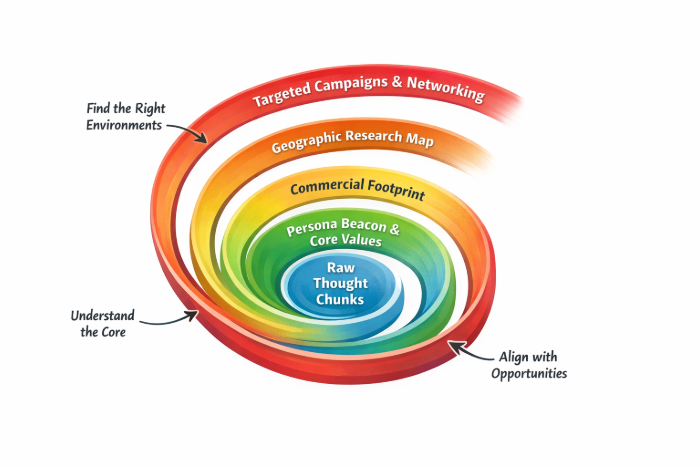
A rough map of the playbook: start at the center with raw thought chunks, then spiral outward through structure, fit, and opportunity.
This playbook 1 of 7
Next ClipThis playbook takes the slower and more useful route: gather the rough material first, then use structured prompts to refine it into a Persona Beacon, a commercial footprint, a geographic research map, and finally a targeted campaign system. It is a few steps, yes, but they all lean toward a friendlier truth: the better you understand the space, the easier it becomes to see where you fit, where you can help, and where the work still needs doing.
Start With Raw Thought Chunks, Not Refined Prediction
Before you ask any predictive system to summarize you, position you, or tell you what your future might look like, give yourself room to think in rough blocks. Write fragments. Write lists. Write contradictions. Write the things you are proud of, the things that drained you, the work you would do again, and the work you never want to repeat. These rough notes are not a draft to be embarrassed about. They are the context layer. They let you compare what a predictive tool gives back against what you actually meant.
That matters for two reasons. First, it gives you a benchmark. If a polished output sounds clever but drifts away from your raw material, you can catch it. Second, it creates room for personal growth. You are no longer accepting a synthetic answer as truth. You are learning where your own thinking sharpens, where it wanders, and where your instincts were already pointing toward a pattern. In that sense, raw thought is not inefficient. It is survival logic. It helps you understand your own signal before the market tries to interpret it for you.
A Stepwise Way to Find Fit
Step Wise Fit 2 of 7
Next ClipBefore we get into the individual steps, it is worth being explicit about what this process is actually doing.
This is not about writing a better bio or sounding more polished.
It is a stepped approach to identifying where you should look for fit based on how you think, what you have done, and the types of problems that naturally pull you in.
Each artifact builds on the one before it. You are not jumping to conclusions. You are narrowing the field.
By the time you reach outreach or networking, you are no longer guessing where you might belong.
You are working from a calculated position one that has been shaped step by step from your own baseline.
With that in mind, the first real move is not to define your persona.
It is to make the environment visible so the persona emerges from real conditions, not assumptions.
In the process behind these documents, the early building blocks were:
- a glossary of terms used in the domain space
- a values layer
- a practical list of things you like to do, can do, and do not want to have to do
- an elevator pitch
- STAR statements
- brand voice notes
The Titles of the Artifacts Tell the Story If You Scan Them Quickly
Those pieces were then used, in sequence, to create the Leader Beacon Persona, the simplified commercial footprint report, the spiral geographic research framework, the “Where is operational trust leaking?” strategic lens, the from here to there ecosystem map, and finally the deep research job search and networking campaign template.
I like this order because it feels humane. You are not forcing identity out of thin air. You are letting it emerge from language, values, evidence, and preference.
IF you understand the language of your work,
THEN you can recognize the patterns within it.
IF you understand your values and constraints,
THEN you can see where you will and won’t operate well.
IF you can describe your signal,
THEN others can understand how you create value.
IF you can prove that signal,
THEN trust begins to form around it.
IF you know where that signal matters,
THEN the search space becomes clearer.
IF you can identify the people and places connected to that need,
THEN conversations become more relevant.
IF you can connect all of that into a system,
THEN you are no longer searching, you are running a campaign.
That is really the playbook in one breath.
Step 1: Capture the Baseline Material Before You “Improve” It
Baseline! 3 of 7
Next ClipStart by generating raw thought chunks in plain language. No optimization. No polishing. No effort to sound impressive.
Useful buckets for a capture stage:
- terms you use naturally in your work
- problems you keep getting pulled into
- projects that made you feel useful
- moments where trust, revenue, time, or quality was leaking
- things that energize you
- things that deplete you
- what you will and will not tolerate in a working environment
Step 2: Turn the Baseline into Foundational Artifacts, Then Refine Them with Prompts
One important detail that is easy to miss when reading this: each step in this playbook is a promptable transformation.
You are not starting from scratch each time. You are carrying forward structured inputs and asking for the next layer of refinement.
In practice, this means each artifact becomes input to the next.
The pattern looks like this:
- Start with raw thought chunks
- Organize them into a structured artifact
- Feed that artifact into the next prompt
- Refine, not replace
This is why the early steps matter so much. If the inputs are shallow, the outputs will be polished but weak. If the inputs are grounded, the outputs become sharper with each step.
A simple working loop:
- Paste your current artifact and any supporting notes into a prompt.
- Include the decision model for the next step.
- Ask for a structured output matching the next artifact.
- Review the result against your original raw thoughts.
- Adjust and refine before moving forward.
You are not asking the model to “figure you out.” You are asking it to help you refine what you already know into clearer structure.
Done well, this becomes a compounding process:
- Each step increases clarity
- Each artifact reduces ambiguity
- Each prompt becomes easier to run
This is also where most of the real work lives. The difference between a generic output and a useful one is not the tool, it is how well the inputs are shaped and how carefully each step is carried forward.
If you enjoy this kind of structured refinement, you can run the process yourself. If not, this is typically the point where people decide they would rather have someone guide the sequence.
Simple Prompt Template:
"Using the following inputs, create the next artifact. Apply the decision model provided and return a structured output. Inputs: [Paste current artifact + notes] Decision Model: [Paste from playbook] Output Format: [Paste expected output section]"
Artifact A: Glossary of Terms
Artifacts 4 of 7
Next ClipDecision model: If a term helps explain the domain, the workflow, the risk, the economics, or the human behavior around the work, include it. If it is only there to sound clever, leave it out.
Artifact B: Values
Decision model: A value only counts if it changes a decision, a boundary, or a behavior.
Using the raw notes, extract values as operating rules rather than personality claims.
How to approach it:
- Only include a value if there is evidence for it in actions, frustrations, choices, or repeated patterns.
- Translate each value into a behavioral rule.
- Distinguish between:
- Non-negotiable values
- Preferred conditions
- Aspirational values still being developed
- Note what each value protects: trust, quality, health, growth, clarity, fairness, reliability, etc.
- Identify which values are most likely to influence role fit, team fit, and company fit.
What you should have at the end:
- A clear values list
- An operational definition of each value
- What each value looks like in practice
- What violates each value
Artifact C: Like / Can / Will Do If Needed / Don’t Want
Decision model: Separate enjoyment from competence, competence from obligation, and obligation from misalignment.
Sort the input into four categories: things this person likes to do, can do, will do if needed, and does not want to have to do.
Why this matters:
This is one of the most useful sorting exercises in the whole playbook because it stops everything from collapsing into a simple “good at” list. A person can be highly capable in work they no longer want to center. They can also have work they would rather avoid but are still willing to do under the right conditions. That middle zone matters.
How to approach it:
- Do not confuse proven capability with preferred work.
- Separate meaningful stretch work from draining work that should only be used tactically.
- Look for overlap:
- Likes + Can do → strongest positioning signal
- Can do + Will do if needed → useful but should be scoped carefully
- Will do if needed + Don’t want to center → boundary and pricing signal
- Don’t want → likely long-term misalignment zone
- Notice which tasks are tolerable only under specific conditions such as team quality, time limits, compensation, or strategic importance.
- Use this exercise to surface role shaping insights, not just task preferences.
What you should have at the end:
- A four part work preference map
- A clearer sense of role fit and misfit
- Better boundaries for future job design, consulting scope, or fractional work
- A more honest picture of where energy is created and where it is consumed
Artifact D: Elevator Pitch
Decision model: Lead with the problem pattern, then the intervention, then the outcome.
Create three versions of an elevator pitch from the materials provided.
How to approach it:
- Start with the recurring problem pattern this person solves.
- Describe the intervention in concrete, practical terms.
- End with the business or human outcome.
- Keep jargon only if it improves clarity or precision.
- Shape each version for a specific context:
- Networking conversations
- Interviews
- Website or “about” sections
What you should have at the end:
- One short, clear version
- One more conversational version
- One slightly more strategic version
- A note on when to use each version
Artifact E: STAR Statements
Decision model: If the story does not show judgment, tradeoff, and outcome, it is not ready yet.
Turn the experience notes into STAR statements that show repeated value creation.
How to approach it:
- Select examples that reveal patterns, not just isolated achievements.
- Prioritize stories where trust, reliability, throughput, clarity, revenue, or adoption improved.
- Make the task specific enough to feel real and grounded in context.
- Show decision making in the action highlight judgment, tradeoffs, and why certain paths were chosen.
- Make the result measurable when possible, and meaningful when it is not.
- Close each STAR with the deeper capability it demonstrates.
What you should have at the end:
- 5 to 8 strong STAR statements
- A clear capability tag for each one
- An understanding of which interview questions each story helps answer
Artifact E2: Brand Voice Interview
Brand Voice 5 of 7
Next ClipDecision model: Brand voice should be elicited from repeated answers under structured pressure, not invented from a few nice sounding phrases.
Before building a brand voice guide, run a structured question set that reveals how the person thinks, reacts, explains, values, and relates when the stakes are real.
Why this matters:
Less than a dozen questions may give you tone, but not much depth. A stronger voice profile usually appears when you ask enough questions to surface patterns across pressure, value, language rhythm, stakeholder posture, and hidden strengths. This is especially important in research driven positioning, where the voice needs to carry both clarity and credibility.
How to approach it:
- Use a structured question set rather than relying on a few open ended prompts.
- Aim for enough questions to surface repeated patterns without creating unnecessary fatigue.
- Group the questions by domain so the responses can be analyzed properly.
- Listen for repeated phrasing, emotional emphasis, contrast words, metaphors, and decision language.
- Pay special attention to answers that reveal identity under pressure, ethical posture, and hidden differentiators.
Recommended domains to cover:
- Identity under pressure — how they see themselves when stakes are high
- Value signal — what they believe matters in business
- Thinking style — how they structure and explain complexity
- Relationship posture — what kinds of people and interactions energize or drain them
- Communication texture — cadence, pacing, phrasing, and explanatory style
- Hidden differentiators — the quiet value they create that others often miss
What you should have at the end:
- A richer set of source material for the final brand voice guide
- Repeated phrases and concepts worth preserving
- Stronger evidence for tone, rhythm, and positioning language
- A voice that sounds discovered rather than manufactured
Artifact F: Brand Voice
Decision model: The voice should sound like the person on a clear day, not like a copywriter impersonating authority.
Build a brand voice guide from the structured interview responses and supporting source material.
How to approach it:
- Capture how this person explains complex ideas when they are thinking clearly and not trying to impress.
- Separate tone (how it feels) from vocabulary (what words are used).
- Define what the voice should feel like to the reader, calm, direct, structured, conversational, and so on.
- Be explicit about what to avoid so the voice does not drift over time.
- Include practical examples across common use cases:
- Website copy
- Outreach notes
- Networking conversation openers
- Short thought leadership paragraphs
What you should have at the end:
- Clear voice principles
- Preferred sentence patterns
- Phrases and structures to lean into
- Phrases and tones to avoid
- Short before-and-after examples to reinforce consistency
Step 3: Use the Foundational Artifacts to Create the Persona Beacon
Persona Beacon 6 of 7
Next Clip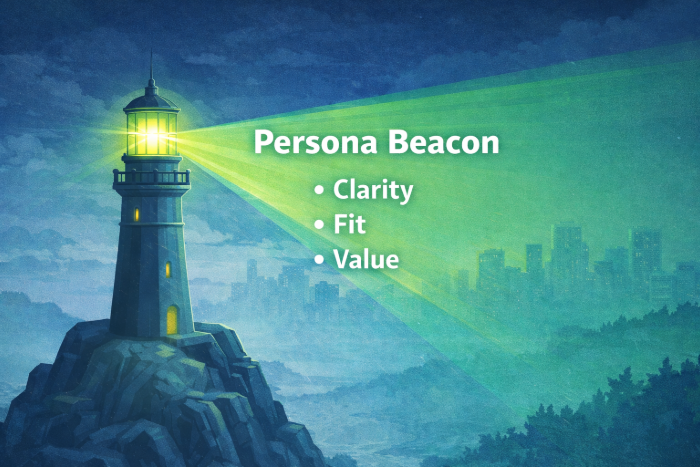
The Persona Beacon: a clear signal of how you create value, guiding the right problems, people, and opportunities toward you.
Once those early documents exist, you can ask for the first serious synthesis.
In this playbook, we begin with the Leader Beacon Persona, a document that identified the core identity, positioning statement, competencies, signature patterns, impact examples, communication style, ideal targets, and aligned contacts.
Artifact G: Persona Beacon
Decision model: The persona should emerge from repeated patterns in the material, not be invented from scratch.
Create a Persona Beacon using the glossary, values, like/can/don’t want framework, elevator pitch, STAR statements, and brand voice.
How to approach it:
- Identify the recurring problem patterns across the source material.
- Define the persona as a functional role, not a job title.
- Extract 5 to 8 core competencies and anchor each in evidence.
- Describe the repeatable operating pattern this person follows when solving problems.
- Surface the strongest proof-of-impact examples.
- Capture the communication style so future writing stays consistent and recognizable.
- Identify the business conditions, industries, and roles where this persona is most valuable.
What you should have at the end:
- A clear archetype
- A concise positioning statement
- A description of what this persona actually does in practice
- Core competencies grounded in real experience
- Signature operating patterns
- Proof of impact
- A values framework in action
- A defined communication style
- Target company profiles
- Relevant roles and contacts
Step 4: Translate the Persona Into a Commercial Footprint
This is where the work stops being inward looking and starts becoming commercially useful.
The simplified commercial footprint report asks a practical question: where does this kind of person solve expensive problems?
Artifact H: Commercial Footprint
Decision model: Translate what you can do into where it matters commercially.
Create a simplified commercial footprint report from the Persona Beacon.
How to approach it:
- Translate competencies into business problems, not just functions.
- Identify operating environments where those problems are frequent, visible, and costly.
- Define the signals that suggest a company may need this kind of support.
- Distinguish between:
- Obvious fit
- Adjacent fit
- Speculative fit
- Note which business models, growth stages, or operating patterns strengthen the fit.
- Highlight where trust, compliance, throughput, revenue leakage, or cross-functional friction increase relevance.
What you should have at the end:
- Clear target conditions
- Relevant industries and sectors
- Profiles of companies where this work matters
- Recognizable signs of operational friction
- A clear commercial rationale for why this persona fits
Step 5: Add Geography Without Letting It Shrink the Search
Geography gets more useful when it is treated as a spiral rather than a pin on a map.
That is why the next artifacts in your sequence are the spiral geographic research framework, followed by the location specific ecosystem map. The idea is simple: start near, expand carefully, and look for clusters of relevance..
Artifact I: Spiral Geographic Research Framework
Decision model: Geography should expand your options, not limit them.
Create a spiral geographic research framework using the Persona Beacon and Commercial Footprint.
How to approach it:
- Start with your home base and define it as the core ring.
- Expand outward in practical layers:
- Local
- Regional
- Adjacent ecosystems
- Remote but aligned environments
- For each ring, identify the types of companies, organizations, and connectors worth researching.
- Favor ecosystems over isolated companies look for clusters of activity.
- Include supply chain relationships, technology overlaps, and professional networks where relevant.
- Be explicit about why each ring matters strategically.
What you should have at the end:
- A clear ring-by-ring search framework
- Target organization types for each layer
- Networking priorities by geography
- Focused research questions for each ring
Artifact J: Ecosystem Map
Decision model: Map relationships, not just companies.
Create an ecosystem map for your selected geography using the Persona Beacon, Commercial Footprint, and spiral framework.
How to approach it:
- Map core companies first, then build outward to the connectors around them.
- Include:
- Employers
- Vendors and suppliers
- Industry associations
- Incubators and accelerators
- Logistics and infrastructure links
- Universities and training programs
- Professional communities
- Prioritize ecosystems where operational trust, system adoption, or cross-functional coordination are critical.
- Note where warm introductions are more likely than cold outreach.
- Flag the most strategically important clusters or subregions and explain why they matter.
What you should have at the end:
- An ecosystem map organized by category
- High-potential clusters of opportunity
- Strategic notes on the strongest zones
- Clear pathways for making contact and building relationships
Step 6: Create a Strategic Lens That Makes Outreach Smarter
Strategic Lense 7 of 7
Next ClipThis process should go beyond “who should I talk to?”. It also gives you a smarter conversation starter.
Artifact K: Strategic Lens
Decision model: If you can name the pattern of failure, you can enter the conversation with value.
Create a strategic lens from the Persona Beacon that can guide research and outreach.
How to approach it:
- Identify the recurring, often invisible failure pattern this persona is best at spotting.
- Turn that pattern into a question that invites diagnosis rather than pitching.
- Make the question broad enough to apply across companies, but precise enough to feel useful.
- Show how this lens can be applied in different contexts:
- Company research
- Networking conversations
- Outreach messaging
- Interview discussions
- Include warning signs and supporting observations that help validate the lens in practice.
What you should have at the end:
- A clear, central strategic question
- Supporting sub-questions that deepen the diagnosis
- Observable signs to look for in companies and conversations
- Practical examples of how to use the lens in real interactions
Step 7: Turn the Whole System Into a Research and Networking Campaign
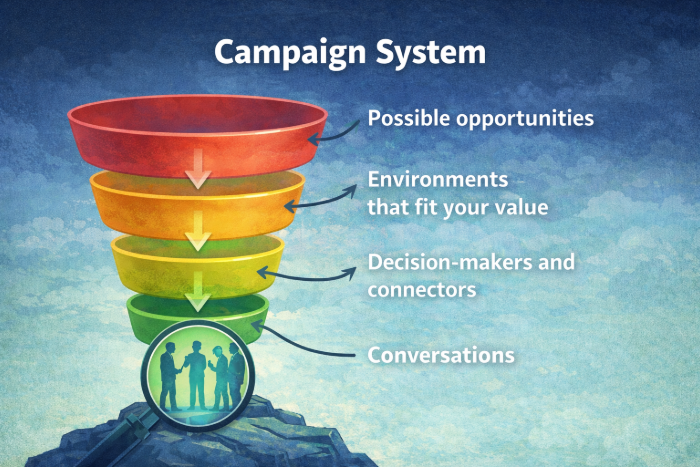
The Campaign System turns broad opportunity into focused conversation—moving from potential fits to real relationships and meaningful dialogue.
By now, the process has done something very handy. It has moved you from “I need a job” to “I understand the kind of environment where I can solve real problems.”
That is the moment where the final campaign template becomes useful.
Artifact L: Campaign System
Decision model: If you understand the environment, the fit, and the problem patterns, then outreach becomes a continuation of research not a separate activity.
Create a deep research job search and networking campaign template using all previous artifacts.
How to approach it:
- Prioritize target companies based on fit, not familiarity or brand recognition.
- Match each company type to the most relevant roles and decision makers.
- Define a clear research path before initiating any outreach.
- Shape outreach around observed business conditions and likely problem patterns.
- Design separate approaches for different interaction types:
- Warm introductions
- Cold outreach
- Association or group based networking
- Follow-up after initial conversations
- Ensure all communication reflects both the brand voice and the strategic lens.
- Track what is learned from each interaction, not just who was contacted.
What you should have at the end:
- A clear campaign structure
- A repeatable target account research template
- Practical outreach message frameworks
- A follow-up sequence that builds momentum
- A simple learning tracker to capture insight over time
- A prioritization method to focus effort where it matters most
Why This Matters Even More If Fractional Work Keeps Growing
One reason this whole method feels timely is the growing likelihood that fractional engagement will become a larger part of the future of work.
If more people are going to work across shorter engagements, advisory arrangements, project based contracts, and hybrid contribution models, then packaging skills clearly will stop being optional. You will need to know what you do, where it creates value, how to explain it, and how to align it to a specific commercial need without rewriting your identity every week.
That future makes this playbook more useful, not less. A Persona Beacon is not just a personal branding exercise. It is a way of turning lived capability into a portable operating offer. And yes, that has a strong connection to pricing model development, which deserves its own post later because once you can package the work clearly, the next question is naturally how that work should be valued.
What This Playbook Is Really Teaching
On the surface, it teaches you how to create a sequence of documents.
But underneath that, it teaches something better:
- how to notice recurring patterns in your work
- how to separate raw truth from polished prediction
- how to turn experience into language
- how to turn language into strategy
- how to move from self-description to market alignment
That is why the steps are worth it. They do not just help you sound better. They help you understand the space better. And when you understand the space better, you can see the gaps that actually need filling.
A Friendly Closing Thought
If this all looks like a lot, that is fair. It is a lot compared with asking a chatbot to “write me a bio.”
But it is also kinder to your future self.
Because instead of chasing polished outputs that may or may not reflect you, you are building from your own benchmark outward. You are learning your territory. You are naming your constraints. You are spotting where trust, time, clarity, margin, or momentum is leaking. And from there, the next step stops feeling random.
It starts to feel earned.