Sifting for Better Decisions
How weak signals become useful when you give them somewhere to go.
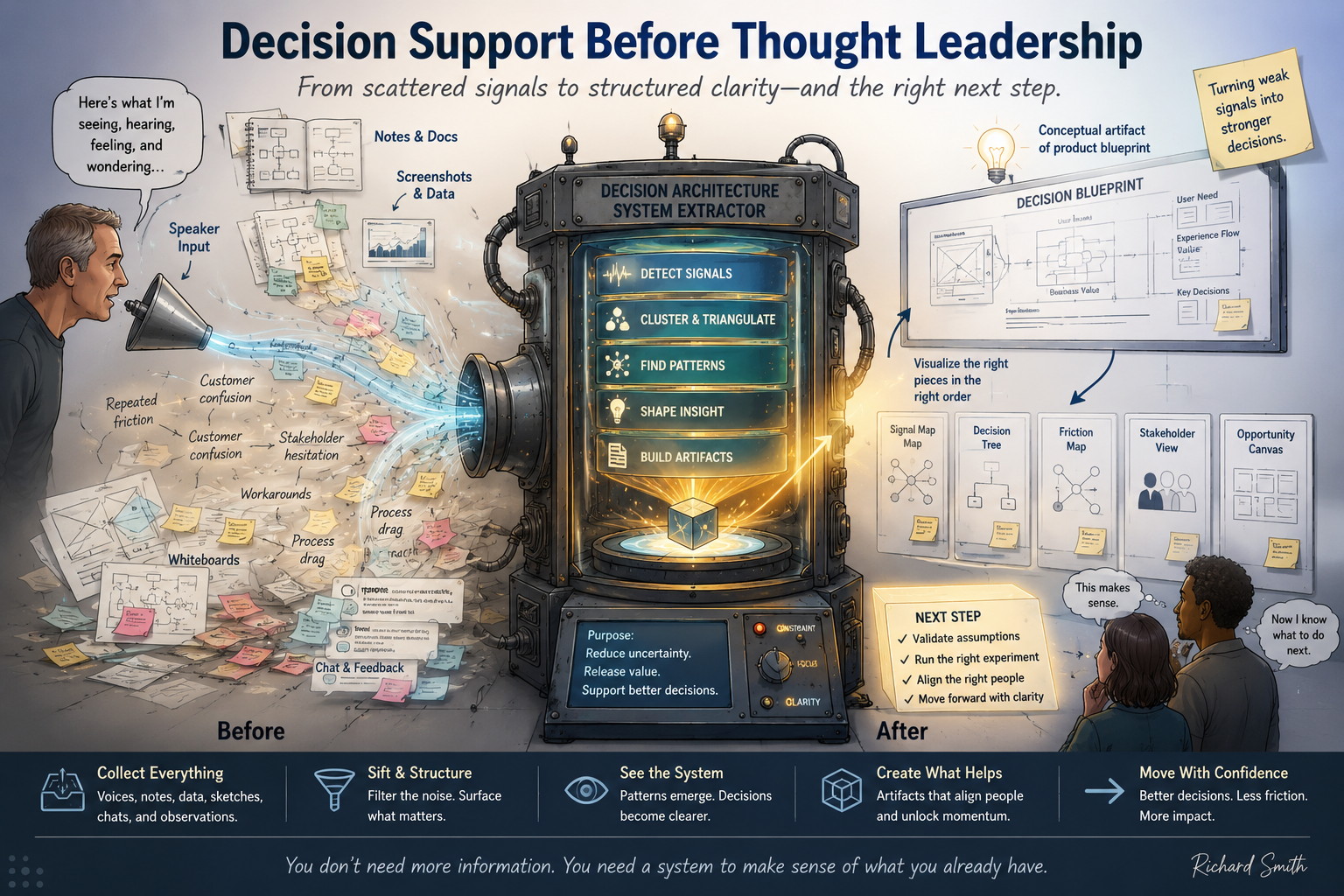
Before getting into the full method, follow one small signal through the sequence. The point is not to solve everything at once. It is to see how a piece of friction can become a clearer decision and then a useful artifact.
Follow a Signal: From Friction to Next Step
Most early signals are too small to act on by themselves. The value appears when we place them beside other signals, ask what decision they support, and choose the artifact that makes the next step easier.
Choose one weak signal to follow
The cards below are the interactive choices. Select the one that feels most familiar to move it through the flow.
What is it?
This is a continuation of the Spiral thinking I shared in the earlier spiral opportunity piece.
In that first version, the goal was to combine existing artifacts and use them to search for signs that a decision was already forming somewhere in the market. The work was about taking what had already been written, mapped, explored, or explained, and using it to build a clearer research template.
This next step moves a little earlier in the process.
Instead of only asking, "Where are decisions already being made?" it asks, "What are the small signals showing up before a decision has a shape?"
That is where the Decision Architecture System Extractor comes in.
It is designed to help sift through rough notes, repeated ideas, customer friction, stakeholder tension, workflows, examples, and half-formed thoughts to find the early focus that may eventually become something useful.
Not every signal is gold.
But if you never sift, you rarely find the piece worth carrying forward.
What does it do for me?
It helps make early thinking less wasteful.
Most of us notice more than we use. We hear a repeated phrase in a meeting. We see a workaround become normal. We feel a handoff getting heavier. We notice that a metric is moving, but nobody is quite sure why. We collect all these small pieces, and then much of it disappears because it was not ready to become a roadmap item, a case study, a proposal, or a product decision.
The extractor gives those signals a place to land.
It helps separate what is merely interesting from what might become useful. Then it helps shape the useful pieces into downstream artifacts: maps, checklists, prompts, decision trees, planning templates, comparison guides, or content that helps someone make a better decision.
It is not trying to replace judgment.
It is trying to support the moment before judgment gets asked to perform.
The short version
This piece moves earlier than the original Spiral method. Instead of only combining existing artifacts, it looks for repeated weak signals, clusters them, names the decision they point toward, and turns that decision into a useful artifact.
A signal cluster
A signal becomes more useful when you can follow it into a decision and then into the right artifact.
Follow a signalTwo Spiral stages
Apply it to a workflow
If you already have a signal cluster forming, the next move is to ask what artifact would make the decision easier: a map, checklist, canvas, comparison guide, calculator, workshop, or sharper question.
Start a conversationThe first Spiral looked outward. This one starts in the dirt.
The original Spiral method was about combining artifacts so they could point toward a more useful direction.
A blog post, a resume section, a case study, a diagram, a service page, a prompt, and a research template could all be pulled together to see what pattern was trying to emerge. The goal was to find evidence that a market, persona, or stakeholder group might already be making decisions that your experience could help with.
That is still useful.
But this piece is about the layer underneath.
Before there is a clean artifact, there is often a messy pile of signals. Some are personal. Some are operational. Some are strategic. Some are just friction that keeps showing up in different clothes.
This is more like planning for gold.
You are not polishing the artifact yet.
You are sieving the material.
You are asking:
- What keeps repeating?
- What feels heavier than it should?
- What are people working around?
- What decision seems delayed because the right shape is missing?
- What value is trapped because nobody has named the pattern yet?
The extractor was built to help with that stage.
It gives the rough material enough structure to become useful without forcing it to become polished too early.
Compare the two Spiral stages
Weak signals are easy to ignore because they rarely arrive with a label.
A weak signal does not usually announce itself as important.
On their own, these signals can feel too small to act on.
That is why they get ignored.
But when several weak signals point in the same direction, they start to tell you something. They may reveal a decision that has not been framed yet. They may show a handoff problem. They may uncover a trust issue. They may show where a team needs a visual, a rule, a checklist, or a clearer path.
This is where business analysis and UX thinking work well together.
The BA side asks, "What is happening in the process?"
The UX side asks, "What is this experience doing to the person moving through it?"
The product side asks, "What decision should this help us make next?"
When those three questions sit together, small signals become much easier to work with.
The value is not always in the signal. Sometimes it is in the combination.
A single weak signal can be misleading.
One support ticket may just be noise.
One stakeholder concern may just be preference.
One metric shift may just be timing.
One confusing screen may just need better copy.
But combinations are different.
A confusing screen plus rising support questions plus a delayed approval step might point to a decision problem. A workaround plus a repeated handoff issue plus unclear ownership might point to a process problem. A metric that moves without explanation plus stakeholder hesitation might point to a trust problem.
This is why I like the idea of triangulating signals.
You are not trying to make every observation important. You are trying to see which observations become meaningful when placed beside each other.
That is the work the extractor is designed to support.
Signal Pattern Atlas
The useful move is not spotting one signal. It is seeing what happens when several small signals start pointing at the same decision.
Orientation gap
Process drag
Trust gap
Context gap
Ownership fog
It helps move from loose notes to pattern, from pattern to decision, and from decision to an artifact that makes the next move easier to see.
That progression matters because most teams do not need more noise. They need a better way to find the few signals worth acting on.
Visual before verbal still matters.
I still believe the visual should usually come before the explanation.
That is not because diagrams are more impressive than words. It is because diagrams make the gaps harder to hide.
A diagram makes the missing part visible
A paragraph can glide past the empty box. The map makes the empty box the point.
This is why the extractor is not only written as a content prompt. It is really a thinking sequence that points toward artifacts.
The written answer is useful, but the better outcome is often a visual: a signal map, decision tree, friction map, stakeholder alignment view, or one-page canvas.
Once the shape is visible, the words become easier.
And usually shorter.
This is decision support before thought leadership.
Thought leadership can be useful, but I am more interested in the work that happens before the polished opinion.
Before you can say something clearly, you often need to understand what you are really seeing.
That is where decision support has value.
It asks quieter questions:
Those questions are not glamorous, but they are useful.
They are also closer to how real product, UX, and business analysis work gets done. Most value is not released because somebody had a big idea in isolation. It is released because somebody noticed the right pieces, put them in the right order, and helped others see what could happen next.
The extractor is meant to support that kind of work.
Not louder thinking.
Clearer thinking.
Choosing the right friction is part of the design.
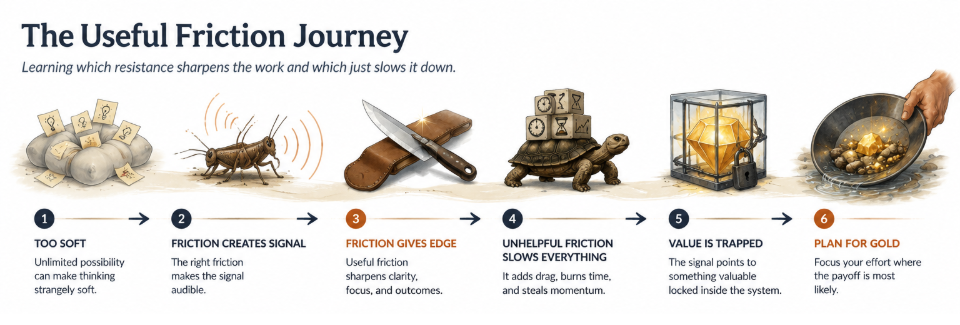
I have come to believe that constraint does more useful work than unlimited possibility.
That may sound strange, because most of us would like fewer blockers, fewer dependencies, and fewer messy tradeoffs. But an environment with no constraint can make thinking strangely soft. If anything is possible, almost nothing is prioritized.
Friction gives the work an edge.
The question is whether it is useful friction.
Useful friction reveals where value is trapped. It shows where people hesitate, where the process gets heavy, where trust is missing, or where a better artifact could make the next decision easier.
Unhelpful friction just burns time.
Part of this method is learning to tell the difference.
 Soft ideas
Unlimited possibility can leave the real priority undefined.
Soft ideas
Unlimited possibility can leave the real priority undefined.
 Sharpened edge
The right constraint gives the work shape and pressure.
Sharpened edge
The right constraint gives the work shape and pressure.
 Trapped value
Useful friction shows where hesitation, trust, or process weight is hiding value.
Trapped value
Useful friction shows where hesitation, trust, or process weight is hiding value.
 Wasted drag
Unhelpful friction consumes attention without making the next decision clearer.
Wasted drag
Unhelpful friction consumes attention without making the next decision clearer.
 Planned gold
Focused effort belongs where the resistance points to something worth building on.
Planned gold
Focused effort belongs where the resistance points to something worth building on.
When a weak signal keeps showing up around the same friction point, it is worth slowing down. Not to overanalyze it forever, but to ask whether that resistance is pointing toward something that matters.
That is what I mean by planning for gold.
You are not trying to mine everything.
You are trying to find the small area where focused effort may produce something valuable enough to build on.
The prompt is the product of the thinking, not the whole value.
The Decision Architecture System Extractor will be available as a lead magnet, but I do not want to present it as a magic prompt.
That would miss the point.
The value is not simply that the prompt produces an output. The value is in the thinking that shaped the sequence.
It starts with surface value because sometimes the obvious things still matter. Then it looks for weak signals. Then it clusters them. Then it turns those clusters into Spiral units. Then it asks what kind of decision architecture could emerge from them. Then it points toward content, visuals, artifacts, and conversion paths.
That sequence is doing the work.
The prompt simply holds the sequence steady long enough for the user to think with it.
That is important because AI can produce a lot of language very quickly. But language is not the same as clarity. The extractor is designed to slow the right parts down and speed the right parts up.
Slow down where judgment is needed.
Speed up where structure helps.
That feels like a better use of AI to me.
What comes after the signal?
This is where the method becomes more practical.
Once a useful signal cluster has been found, the next question is not "How do we write about this?"
At least not first.
The better question is:
"What would make this easier for someone else to decide?"
What Should This Become?
The right artifact depends on the decision the signal is trying to support.
That downstream artifact should match the decision.
The format is not the starting point. The decision is. Once the decision is clearer, the right artifact usually becomes easier to choose.
This keeps the content from becoming content for its own sake.
The artifact has a job.
Request the Decision Architecture Extractor
I am making the extractor available as a practical download for people who want to test this against their own notes, drafts, or planning material.
You do not have to use the whole system at once.
Start with the signal that keeps bothering you.
Follow it until it points to a decision.
Then choose the smallest artifact that would make that decision easier.
That might be the short version, the diagram, the Spiral connection, the extractor, or just one useful idea carried into the next meeting.
The point is not to force every reader or team through the same path. The point is to give the signal somewhere useful to go.
Where this goes next.
The Spiral method helped me think about combining artifacts to find opportunity.
This next layer helps me think about what happens before the artifact exists.
That feels important.
Because a lot of useful work starts as something much rougher than a finished page, service offer, case study, or template. It starts as a note. A pattern. A hesitation. A repeated conversation. A small friction point. A sense that something is there, but not quite visible yet.
The Decision Architecture System Extractor is my attempt to give that early material a better path.
That is the progression.
Not content for attention alone.
Content as decision support.
And if the work is done well, the next step should feel less forced because the signal has already shown you where to look.
Signup to receive my agent description. Use it, break it, remake it
I am making the Decision Architecture System Extractor available as a practical resource for people who want to test this approach against their own notes, content, workflows, or planning material.
It will not make the decision for you.
But it can help you see what your rough material may already be trying to tell you.
If you are working through early-stage product thinking, unclear stakeholder signals, scattered content ideas, or a planning problem that feels like it has value trapped inside it, this may be a useful place to start.
Request the Decision Architecture System ExtractorOr, if you already have a signal cluster forming and want help turning it into a clearer artifact, connect with me and we can talk through what the next shape might be.
Use the form below to request the extractor. Your request will be tagged so I know this is the resource you wanted.